By Zhaolan Wang
The Prohibiting Social Media Manipulation Act is a bipartisan law aimed at protecting youth by imposing safeguards such as time limits, content filters, and parental controls to reduce exposure to harmful online content.
The law reduces young people’s exposure to unhealthy information and will take effect on July 1, 2025, according to the Minnesota House of Representatives file. Rep. Zack Stephenson, DFL-Coon Rapids, proposed the law, which allows users to determine their security settings more.
Christopher Terry, an associate professor of law and policy at the University of Minnesota, said the government doesn’t have much authority over this law.
Terry said the only thing the government can do under current law is hold companies accountable to whatever they say.
“The simple reality is most social media platforms or internet sites very clearly disclose what kind of data is collected on you and what happens to that data, how it’s used, sold, repackaged,” Terry said. “The problem is most people don’t read. Making a platform say more about what that data is, or how it’s collected. That doesn’t change the fact unless everybody’s going to read those disclosures.”
Stephenson said the Prohibiting Social Media Manipulation Act is largely in response to the Minnesota attorney general’s report on emerging technology, according to FOX 9 News.
On Feb 1, 2024, Attorney General Keith Ellison released a report detailing the harmful effects of social media on Minnesota’s youth, highlighting issues such as cyberbullying, exposure to harmful content and compulsive technology use, according to the Minnesota Attorney General’s Office file.
The Legislature commissioned the report, offering recommendations for policymakers to create a safer online environment, including banning manipulative design features and implementing privacy safeguards.
Hannah Kovnar, a student at the University of Minnesota said she is in a gray area about it.
“I feel it might accidentally end up with a lot of people filtering out the correct information and then not knowing how to fact check what they are getting,” Kovnar said.
Terry said he is quite capable of determining what’s OK for his kids in the view of parents.
“For my kids, I don’t need the government to be all paternalistic and tell me I have to do this same thing for screen time. That’s my job as a parent. I don’t want to be all libertarian about it, but that’s how I feel,” Terry said.
In January, the Minnesota Age-Appropriate Design Code Act, modeled after a law passed in California, increased the protection of a child user’s data while obligating a business operating in Minnesota to regulate the design and settings of a product to ensure protection while providing privacy notices for its users, according to the Minnesota Legislature file.
Stephenson said nothing meaningful has changed on the federal level, but he wants to put the user more in control, according to the Star Tribune news.
“To the extent they’re even doing anything about social media, it’s trying to ban TikTok,” he said.
Terry said the only power the government has over social media platforms right now is to make them say what they’re going to do. When they don’t do that, the government goes after them for deception.
“The government’s trying to implement the TikTok ban would overturn older laws that protect the internet differently than commercial speech or political speech, and that will give them a lot more power,” Terry said. “The court would have a lot more power to do things on this in terms of commercial speech.”
As of fall 2020, 69% of US teenagers were on monthly TikTok, according to a study from Jodi Dworkin’s, a University of Minnesota social science professor specializing in teen technology and social media use.
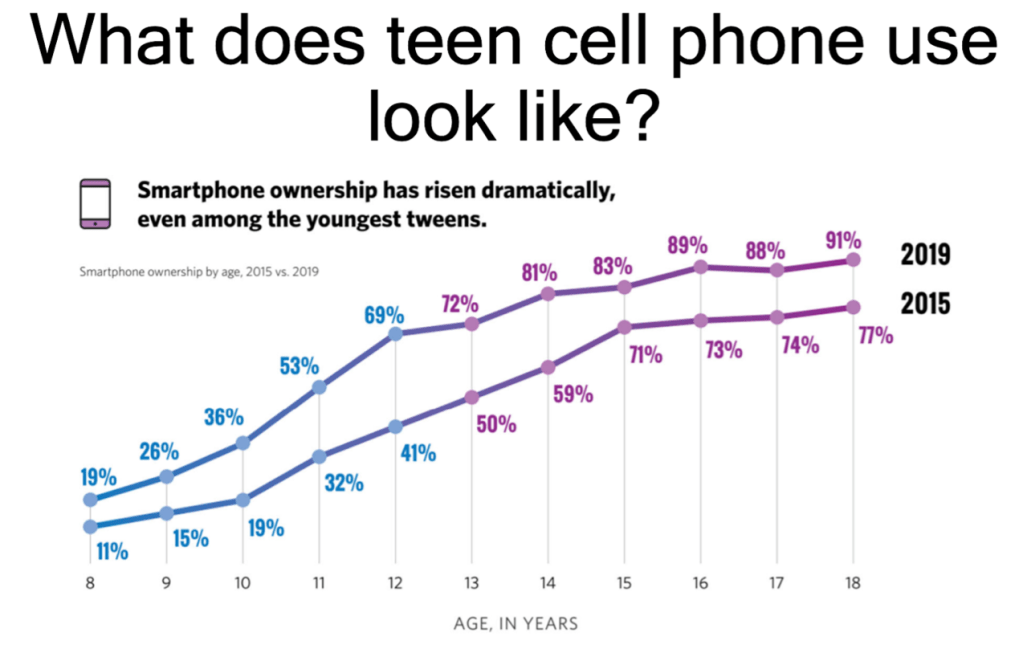
Teenager’s cell phone use chart from Dworkin’s research on Jan. 25, 2022.
In the United States, 95% of teenagers have access to a smartphone and 45% said they are online “almost constantly,” according to a 2018 Pew Research Center survey. In Minnesota, teenagers use their phones for more than three hours and 49 minutes per day, according to a 2023 telematics and informatics research.
A quarter of teenagers use their phones for more than five hours and 30 minutes per day, according to the research.
Students at the University of Minnesota said there should be an age limit on social media.
Jaelyn Sather, a student at the University of Minnesota said she feels age limits will have a big impact.
“It’s weird to see a 10-year-old child on TikTok, and I feel only 14-year-old and up should use that kind of social media,” Sather said.
There is no clear consensus among teens about the impact of social media platforms, with 24% of teens believing the impact is primarily negative, according to the 2018 survey.
“I think there should be a little bit better age restriction,” Kovnar said. “My friends and I all joke about having unrestricted Internet access as a kid. I don’t think that was necessarily the healthiest thing for growing up. I think there is a lot of content that can be toxic to young children.”
Sources List:
- Christopher Terry
- FOX 9 News
- Hannah Kovnar
- Jaelyn Sather
- Jodi Dworkin’s Research
- The Minnesota House of Representatives File
- The Minnesota Attorney General’s Office File
- The Minnesota Legislature File
- The Star Tribune News
- The Prohibiting Social Media Manipulation Act
- 2023 Telematics and Informatics Research
- 2018 Pew Research Center survey

 Zhaolan Wang
留下评论